

multicall

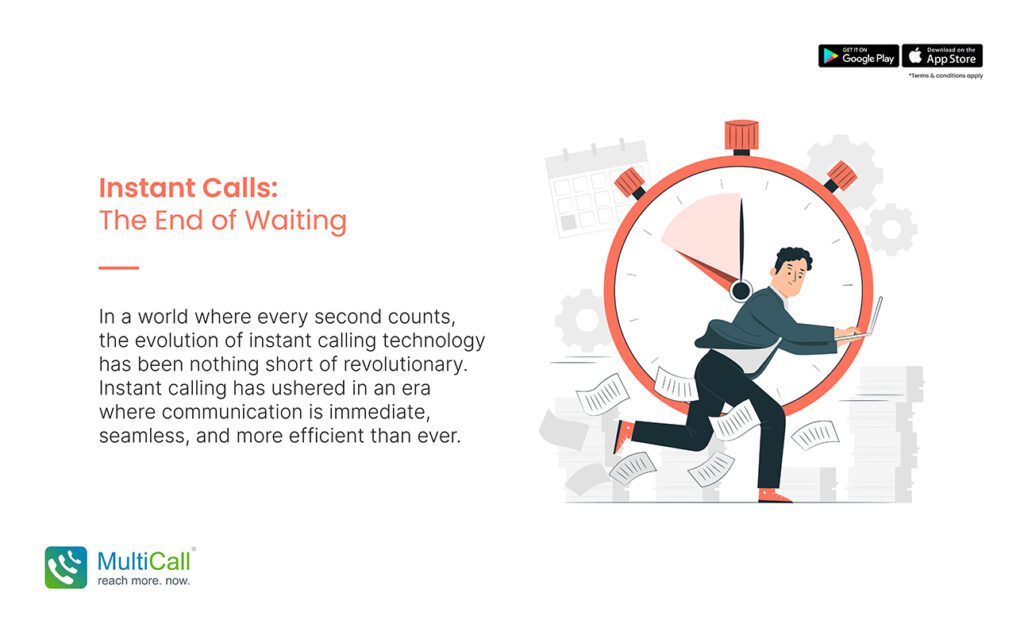
Instant Calls: The End of Waiting

In a world where every second counts, the evolution of instant calling technology has been nothing short of revolutionary. Gone are the days of enduring long waits and cumbersome processes to connect a call. Instant calling has ushered in an era where communication is immediate, seamless, and more efficient than ever. This change has significant implications not just for personal interactions, but also for business communications, customer service, and remote work.


The Shift to Instant Connectivity

Traditional calling systems often involved delays due to various factors like network congestion, manual dialing, or routing issues. Instant calling technology, leveraging advanced networks and smart algorithms, has effectively put an end to these waiting times. Today, a call is often just a click or a tap away, regardless of the geographical distances between the participants.

Benefits of Instant Calling

  1. Enhanced Productivity: In business environments, the ability to connect instantly with colleagues or clients translates to quicker decision-making and improved workflow efficiency.

  2. Better Customer Experience: Customer service has benefited immensely, with instant connections leading to faster resolution of queries and a more satisfying customer experience.

  3. Personal Communication Redefined: For personal calls, instant connectivity means being able to share moments and experiences in real-time, strengthening relationships despite physical distances.

  4. Facilitation of Remote Work: The rise of remote work has been significantly supported by instant calling, enabling teams to collaborate effectively from different locations.

Scenarios Where Instant Calls Shine

  1. Business Meetings: Organizing and conducting business meetings has become more streamlined, with participants able to join calls promptly without any waiting.

  2. Customer Support: Customer support centers now provide quicker responses, greatly improving customer satisfaction and loyalty.

  3. Emergency Services: In critical situations, the ability to make instant calls can be life-saving, providing immediate access to emergency services.

Maximizing the Potential of Instant Calls

– Integration with Workflows: Businesses should integrate instant calling features into their workflows for maximum efficiency.

– Training and Adaptation: Users and employees should be trained to adapt to and leverage the full potential of instant calling technology.

– Quality and Reliability: Continuously ensure the quality and reliability of the technology to maintain seamless communication.

Conclusion

Instant calling technology has effectively marked the end of the waiting era in communication. It has redefined expectations and set new standards for how we connect with others, both in our personal lives and professional environments. By embracing this technology, individuals and businesses can enjoy a level of connectivity and efficiency that was once unimaginable.

Contact Form


apple-store-app
google-play-app

YOU MAY ALSO LIKE

group calls

When Every Second Counts: The Power of Instant Group Calls

In today’s fast moving business environment, speed plays a critical role in success. Whether it is handling urgent issues, making quick decisions, or coordinating teams, every second matters. Delays in communication can lead to missed opportunities, operational disruptions, and reduced productivity. This is where instant group calls become a powerful solution for businesses.

Read More »
communication

What Real-Time Communication Looks Like in Large Enterprises

Large enterprises operate in complex environments where multiple teams, departments, and locations must work together seamlessly. In such settings, real time communication is not just an advantage, it is a necessity. It ensures that information flows quickly, decisions are made efficiently, and operations continue without disruption.

Read More »
collaboration

The Future of Enterprise Collaboration Is Simpler Than You Think

Enterprise collaboration has evolved significantly over the years. From long email threads to complex project management tools, businesses have continuously tried to improve how teams work together. However, as systems become more advanced, they often become more complicated. The future of collaboration is not about adding more layers, but about simplifying communication to make it faster, clearer, and more effective.

Read More »
audio

Why Crisis Communication Needs Voice, Not Text

In times of crisis, communication becomes the most critical factor in managing situations effectively. Whether it is an operational issue, a service disruption, or an internal emergency, the way information is shared can determine how quickly and efficiently the problem is resolved. While text based communication has its place, voice communication proves to be far more reliable and impactful during high pressure situations.

Read More »
productivity

The Silent Killer of Business Productivity: Poor Coordination

In many organizations, productivity issues are often blamed on workload, lack of resources, or tight deadlines. However, one of the most overlooked factors is poor coordination. When teams are not aligned, even simple tasks can become complicated, leading to delays, confusion, and reduced efficiency. This silent issue can slowly impact overall business performance if not addressed properly.

Read More »
multicall

  How Audio-First Communication Reduces Decision Fatigue

Decision fatigue happens when individuals are required to make too many choices in a short period of time. In business environments, this often comes from constant messages, emails, and multiple communication tools demanding attention. Over time, this overload reduces the ability to think clearly and make effective decisions. A simpler communication approach can help reduce this mental strain

Read More »