


How PSTN-Based Group Calling Improves Reliability in Business Communication
In today’s fast-paced business setting, where swift choices and geographically dispersed teamwork are the norm, dependable communication emerges as an essential requirement.


What exactly comes do your mind when you hear ‘Networking’? A shuffle and draw of business cards? Tricky conversations with forced smiles? Here’s the good news for you: all that is not needed!
Attending events and dumping contact information to as many people as possible is a start, but it is not networking. Would you have any form of relationship with someone if you merely dropped them your number and email?
Genuine connections are what you need, and getting them takes time, effort, tools and a few steps. But the current aspect of distancing due to Covid-19 means that this has to be handled remotely on call. On that note, master your next business networking call in just 8 steps:


Your network helps as a useful stepping stone toward achieving your goals. But no one wants to be taken merely for that. The idea of networking is to foster reliable relationships, not connections that are functional.
So how do you start your networking slate? Believe it or not you already know how. You’ve been building relationships since you were born. It’s simply a matter of using the same skills, now to intentionally build relationships with people who are interesting, creative and successful.
As the old adage goes, “Strangers are friends you haven’t met yet”. This comes down to a few simple tactics while on call:
Don’t be all about business when starting off. Foster meaningful relationships, taking active interest in their likings too. Make the conversations about them, bringing up your own experiences to concur and empathize with them.
You have 15 minutes to make a first impression with your contacts and get your questions answered. How are you going to use it? The last thing you’d want to do is waste that precious time by asking questions that could have been easily answered with a quick look at their profiles, or their company’s website.
To make an impression is a bit like marketing yourself, so you do want to impress your contact by exceeding their expectations with your knowledge. To go beyond what’s expected, calls for research. As with effective group conferencing, preparation is paramount to effective business networking. So plan for a perfect networking call.
Learn as much as you can about the contacts you’re going to speak to, their company or industry, and be prepared with the necessary questions, along with some of your own knowledge. But the planning doesn’t stop there.


The call will need to be set in good timing as well for their convenience. Keeping the conference hour close to a pre-determined break in a day’s routine (such as lunch) may cause the conference call to inadvertently result in multiple risky scenarios.
First, you may be omit or condense critical points of interest, and your contacts may not be nearly as attracted to continue the conversation with you.
Second, rushing also may lead them to misunderstand that you’re not really interested in what they have to say, discouraging them from having a discussion.
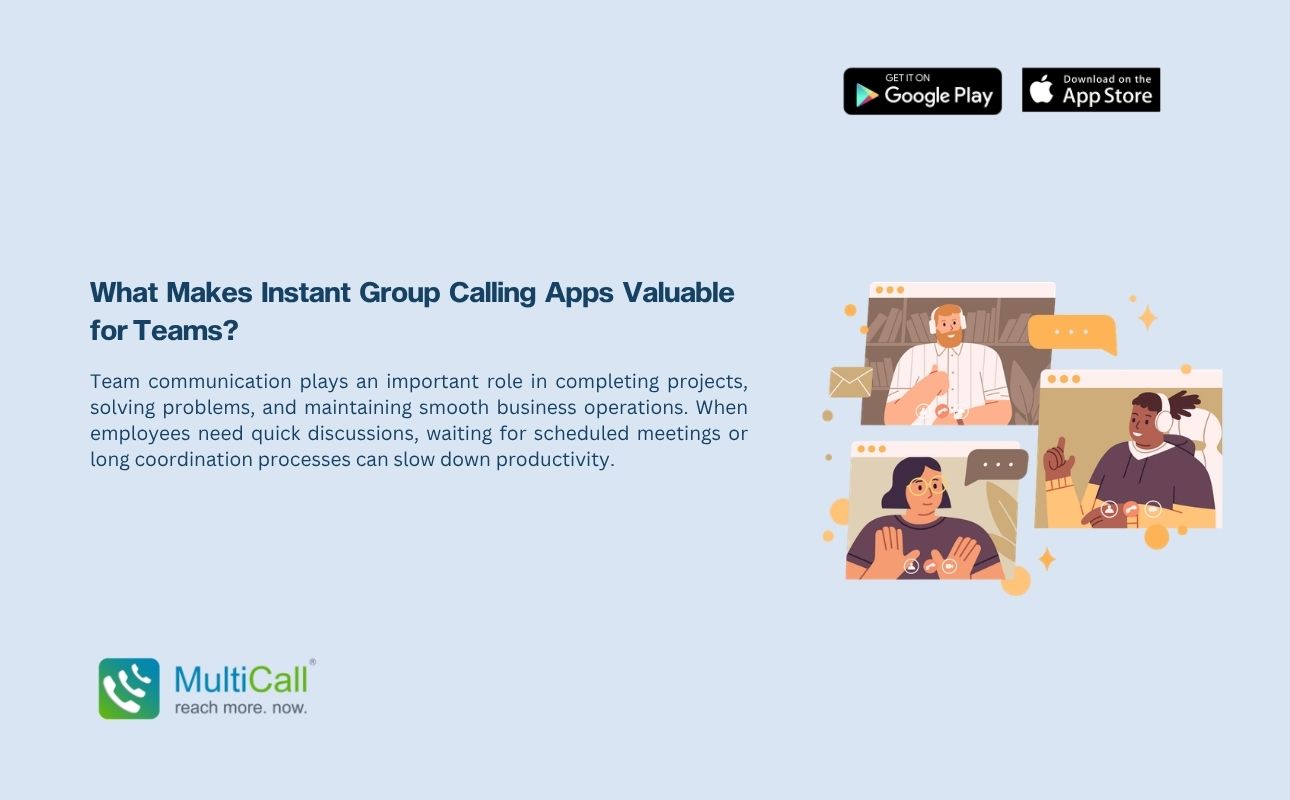
MultiCall would serve as a useful tool at this point. Not only does it allow carrying outgroup calling in one go, there is no hassle typical of conferencing either.


In today’s fast-paced business setting, where swift choices and geographically dispersed teamwork are the norm, dependable communication emerges as an essential requirement.


With companies more frequently embracing work-from-anywhere and hybrid setups, team get-togethers have transformed from casual chats into key strategy sessions. These sessions frequently handle sensitive details, involve diverse functional groups, and necessitate prompt determinations.


In rapidly evolving business settings, output levels closely correlate with team interaction quality. Spontaneous calls, absent gatherings, and conflicting agendas frequently result in muddles and lost hours.


Working remotely has transformed from a stopgap measure into a sustained operational structure for numerous enterprises. With teams spreading out geographically, conventional methods for gathering face challenges in achieving the focus and lucidity vital for productive teamwork.


Within the present-day commercial landscape, the pace and precision of conveying information directly influence output. Work groups are no longer restricted to one physical location, and working together frequently occurs across various cities, nations, and differing clocks


Throughout healthcare, finance, and public administration, the requirement for guarded, precise, and instant dialogue is at an all-time high. These fields handle private data, secret documents, and vital activities, positioning their conversation methods as a core component of everyday tasks.