
multicall

INTEGRATING MULTICALL WITH CRM, TASK AND WORKFLOW TOOLS FOR SEAMLESS

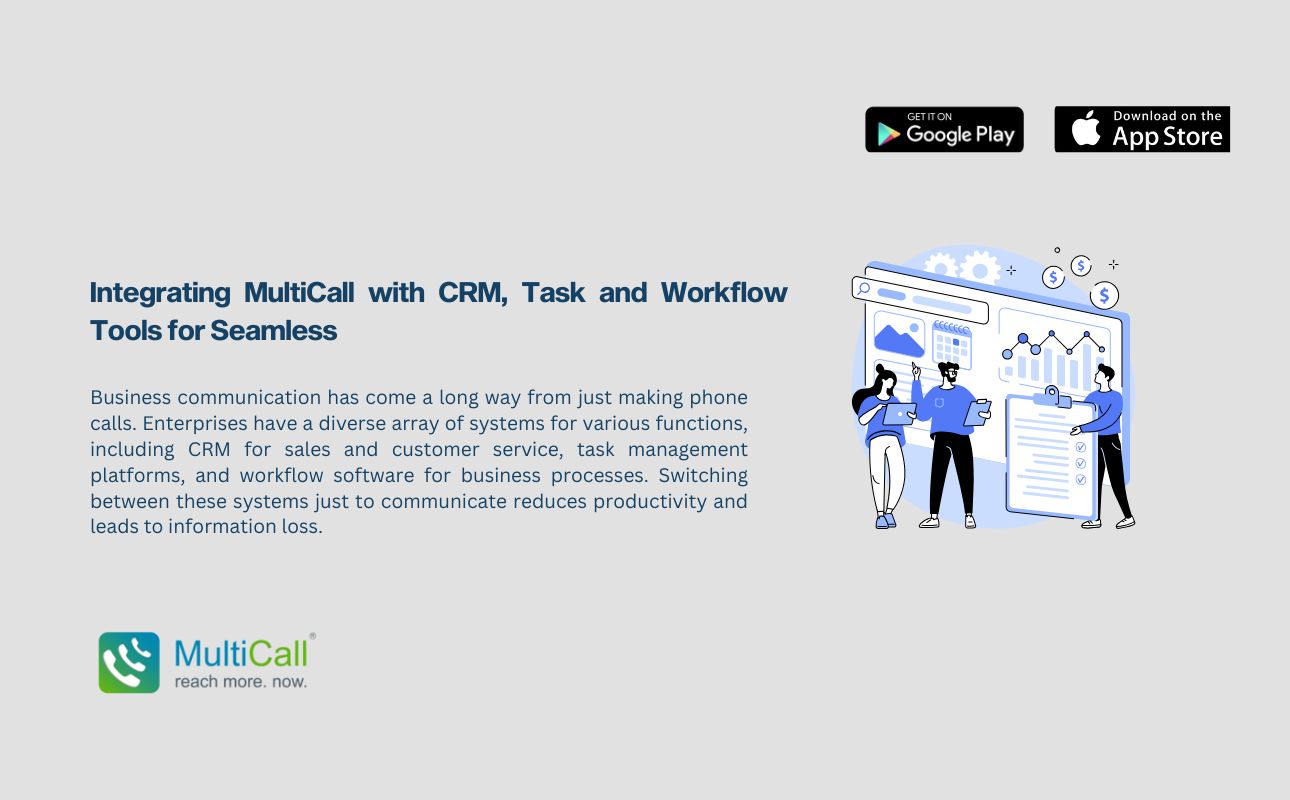
Business communication has come a long way from just making phone calls. Enterprises have a diverse array of systems for various functions, including CRM for sales and customer service, task management platforms, and workflow software for business processes. Switching between these systems just to communicate reduces productivity and leads to information loss.

MultiCall and CRM Systems: Enhanced Customer Engagement

CRM systems are used across sales, support, and account management teams to keep customer interactions organized and productive. Integrating MultiCall with your CRM brings multiple advantages.

  • Call from a CRM Record: Sales or support agents can initiate a MultiCall directly from a CRM contact’s record, without having to leave the app to pick up the phone.
  • Automatic Call Logging: Automatically add the time, duration, and participants of a call to the contact’s record.
  • Reduce Email and Chat Chatter: Rather than endless email threads or off-topic chat discussions, a quick MultiCall provides faster issue resolution and accountability.
  • Add Follow-Up Action:Calls can be linked to a specific task, providing a communication trail alongside project updates.

This makes sure that communication is aligned with specific tasks or deliverables, reducing time and preventing information loss.

Workflow Tools:

 MultiCall integration with these tools makes collaboration natural, fast, and without any disruption in the existing workflow.

  • Send a Call: Team members can use alerts or chat to notify someone, but also immediately trigger a MultiCall when urgent input is needed.
  • Add Cross-Team Communication: For sales, support, and operations workflows that span multiple teams, MultiCall group calls bridge the gap.
  • Call Participants Scale: Calls can be 1:1 or larger, depending on what the workflow needs for real-time discussion.

The integration of MultiCall helps remove friction from otherwise rigid workflows and prevents project bottlenecks, allowing teams to meet deadlines faster.

Advantages of Integrating MultiCall with CRM, Task, and Workflow Tools

Integrating MultiCall into CRM systems, task management, and workflow software offers several significant benefits:

  • Centralized Communication: Having calling and conferencing in the same tool as the rest of your operations for customers or team members means less friction and more efficient communication.
  • Time Efficiency:When MultiCall is integrated into other tools, employees no longer have to switch between separate systems for communication.
  • Better Productivity:Teams can resolve blockers instantly through contextual calling and remain on task.
  • Improved Insights: Integrating call data and analytics with CRM or tasks allows for better tracking and analysis of team or employee communication.
  • Scalability:As teams and projects expand, MultiCall integrations ensure communications don’t need to scale in complexity.

The future of communications is in connected ecosystems, where all tools seamlessly interoperate to minimize silos and keep information flowing as seamlessly as tasks or customer data. MultiCall’s commitment to integration places it as a critical enabler of this future.

Conclusion

Organizations that integrate with MultiCall can stay on the same page, address issues before they become problems, and be more productive at all levels. For larger organizations looking to get the biggest return on their communication investments, the ability to integrate MultiCall with other tools they are already using is not just a ‘nice-to-have’ feature; it’s a requirement. Call us today to gather more details.

Contact Form


apple-store-app
google-play-app

YOU MAY ALSO LIKE

collaboration

The Future of Enterprise Collaboration Is Simpler Than You Think

Enterprise collaboration has evolved significantly over the years. From long email threads to complex project management tools, businesses have continuously tried to improve how teams work together. However, as systems become more advanced, they often become more complicated. The future of collaboration is not about adding more layers, but about simplifying communication to make it faster, clearer, and more effective.

Read More »
audio

Why Crisis Communication Needs Voice, Not Text

In times of crisis, communication becomes the most critical factor in managing situations effectively. Whether it is an operational issue, a service disruption, or an internal emergency, the way information is shared can determine how quickly and efficiently the problem is resolved. While text based communication has its place, voice communication proves to be far more reliable and impactful during high pressure situations.

Read More »
productivity

The Silent Killer of Business Productivity: Poor Coordination

In many organizations, productivity issues are often blamed on workload, lack of resources, or tight deadlines. However, one of the most overlooked factors is poor coordination. When teams are not aligned, even simple tasks can become complicated, leading to delays, confusion, and reduced efficiency. This silent issue can slowly impact overall business performance if not addressed properly.

Read More »
multicall

  How Audio-First Communication Reduces Decision Fatigue

Decision fatigue happens when individuals are required to make too many choices in a short period of time. In business environments, this often comes from constant messages, emails, and multiple communication tools demanding attention. Over time, this overload reduces the ability to think clearly and make effective decisions. A simpler communication approach can help reduce this mental strain

Read More »
multicall

 The Problem With Too Many Tools in Enterprise Communication

Modern enterprises often adopt multiple tools to manage communication across teams. From chat apps to emails and various platforms, the intention is to improve efficiency. However, using too many tools can create confusion instead of clarity. Employees may struggle to keep track of conversations, leading to missed information and reduced productivity.

Read More »
multicall

 Why Leaders Prefer Voice Over Messaging During High-Stakes Decisions

High-stakes decisions require complete clarity and confidence. Leaders cannot afford misunderstandings or delays when making important choices that impact the business. Messaging platforms may seem convenient, but they often lack the depth needed for complex discussions. Voice communication allows leaders to explain ideas clearly, ensuring that every detail is understood. With Best Audio Conferencing Apps, leaders can connect instantly and communicate with precision during crucial moments.

Read More »