

multicall

Integrate Voice API for Enhanced Communication Capabilities

Introduction

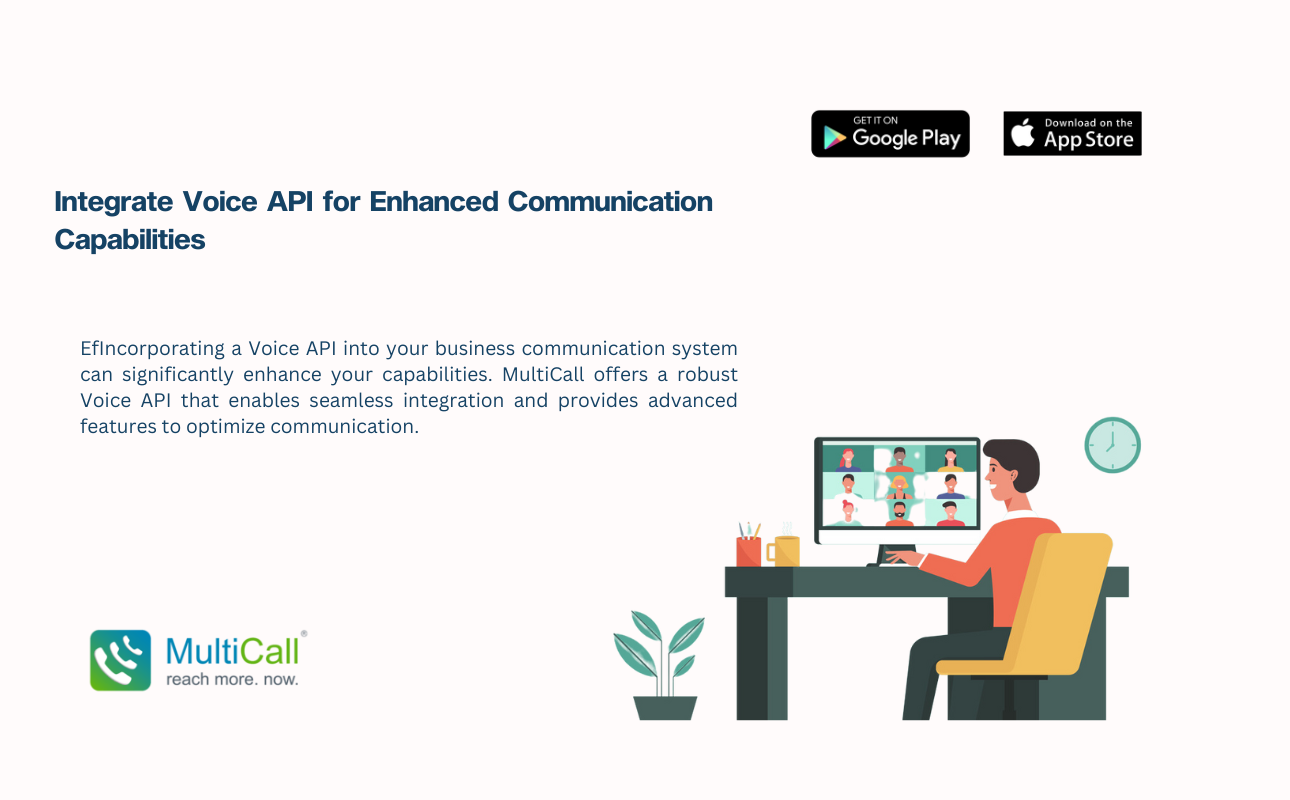
Incorporating a Voice API into your business communication system can significantly enhance your capabilities. MultiCall offers a robust Voice API that enables seamless integration and provides advanced features to optimize communication.

Key Features of MultiCall’s Voice API

  1. Seamless Integration: The MultiCall Voice APIeasily integrates with your existing systems, allowing you to enhance your communication capabilities without overhauling your current infrastructure.
  2. High-Quality Audio: Utilizing PSTN-based calling, the Voice API ensures high-quality audio for all communications, reducing disruptions and improving clarity.
  3. Customization: Tailor the API to meet your specific business needs, whether it’s for customer service, internal communication, or automated responses.

Benefits of Integrating MultiCall’s Voice API

Enhanced Communication: By integrating the Voice API, businesses can streamline their communication processes, ensuring consistent and reliable interactions.

Cost Efficiency: The MultiCall Voice API offers a cost-effective solution by reducing the need for additional hardware and infrastructure investments.

Scalability: As your business grows, the Voice API can scale with you, providing the flexibility to add more features and users as needed.

Security: MultiCall prioritizes security, with features like number masking and end-to-end encryption, ensuring all communications are secure and private.

Use Cases for MultiCall’s Voice API

  1. Customer Service: Enhance customer service operations by integrating the Voice APIto handle high volumes of calls efficiently.
  2. Internal Communications: Improve internal communication with high-quality, reliable voice interactions, essential for remote teams and large organizations.
  3. Automated Responses: Use the Voice APIto automate responses for common inquiries, saving time and improving efficiency.

Implementation Steps

  1. Evaluate Your Needs: Determine the specific requirements for integrating the Voice APIinto your system.
  2. API Integration: Work with your IT team to integrate the MultiCall Voice APIseamlessly with your existing infrastructure.
  3. Customization: Customize the API settings to match your business operations and communication needs.
  4. Testing and Deployment: Thoroughly test the integration to ensure everything functions correctly before full deployment.
  5. Monitor and Optimize: Continuously monitor the performance and make necessary adjustments to optimize the communication experience.

Conclusion

Integrating the MultiCall Voice API can transform your business communication capabilities, offering high-quality, reliable, and secure voice interactions. Whether for customer service, internal communications, or automated responses, the Voice API provides the flexibility and scalability to meet your business needs. Enhance your communication strategy with MultiCall and experience the benefits of advanced voice technology.

Contact Form


apple-store-app
google-play-app

YOU MAY ALSO LIKE

communication breakdown

How Enterprises Can Avoid Communication Breakdowns

Communication is the foundation of every successful enterprise. When communication flows smoothly, teams stay aligned, decisions are made quickly, and operations run efficiently. However, when communication breaks down, it can lead to confusion, delays, and costly mistakes. For large enterprises, avoiding these breakdowns is essential to maintain productivity and performance.

Read More »
audio

Why Reliable Audio Infrastructure Is a Competitive Advantage

In today’s competitive business environment, communication is not just a support function, it is a strategic advantage. Companies that communicate faster, clearer, and more reliably often outperform others. While many organizations focus on tools and platforms, the real strength lies in having a reliable audio infrastructure that supports seamless communication at all times

Read More »
group calls

When Every Second Counts: The Power of Instant Group Calls

In today’s fast moving business environment, speed plays a critical role in success. Whether it is handling urgent issues, making quick decisions, or coordinating teams, every second matters. Delays in communication can lead to missed opportunities, operational disruptions, and reduced productivity. This is where instant group calls become a powerful solution for businesses.

Read More »
communication

What Real-Time Communication Looks Like in Large Enterprises

Large enterprises operate in complex environments where multiple teams, departments, and locations must work together seamlessly. In such settings, real time communication is not just an advantage, it is a necessity. It ensures that information flows quickly, decisions are made efficiently, and operations continue without disruption.

Read More »
collaboration

The Future of Enterprise Collaboration Is Simpler Than You Think

Enterprise collaboration has evolved significantly over the years. From long email threads to complex project management tools, businesses have continuously tried to improve how teams work together. However, as systems become more advanced, they often become more complicated. The future of collaboration is not about adding more layers, but about simplifying communication to make it faster, clearer, and more effective.

Read More »
audio

Why Crisis Communication Needs Voice, Not Text

In times of crisis, communication becomes the most critical factor in managing situations effectively. Whether it is an operational issue, a service disruption, or an internal emergency, the way information is shared can determine how quickly and efficiently the problem is resolved. While text based communication has its place, voice communication proves to be far more reliable and impactful during high pressure situations.

Read More »