Communication is two-sided: managers need tools to monitor their health. The Call Monitoring Dashboard is a feature of MultiCall, a reimagined group calling app. Call Monitoring Dashboard not only enables seamless group calling but also provides organizations with visibility and insights into their teams’ calling activity.
Managers can now measure communication health with granularity using dashboard features like participation tracking and call duration. In this article, we will look at the Call Monitoring Dashboard in detail and examine how businesses can use it to boost efficiency, optimize team engagement, and promote data-informed decision-making.
Understanding the Call Monitoring Dashboard
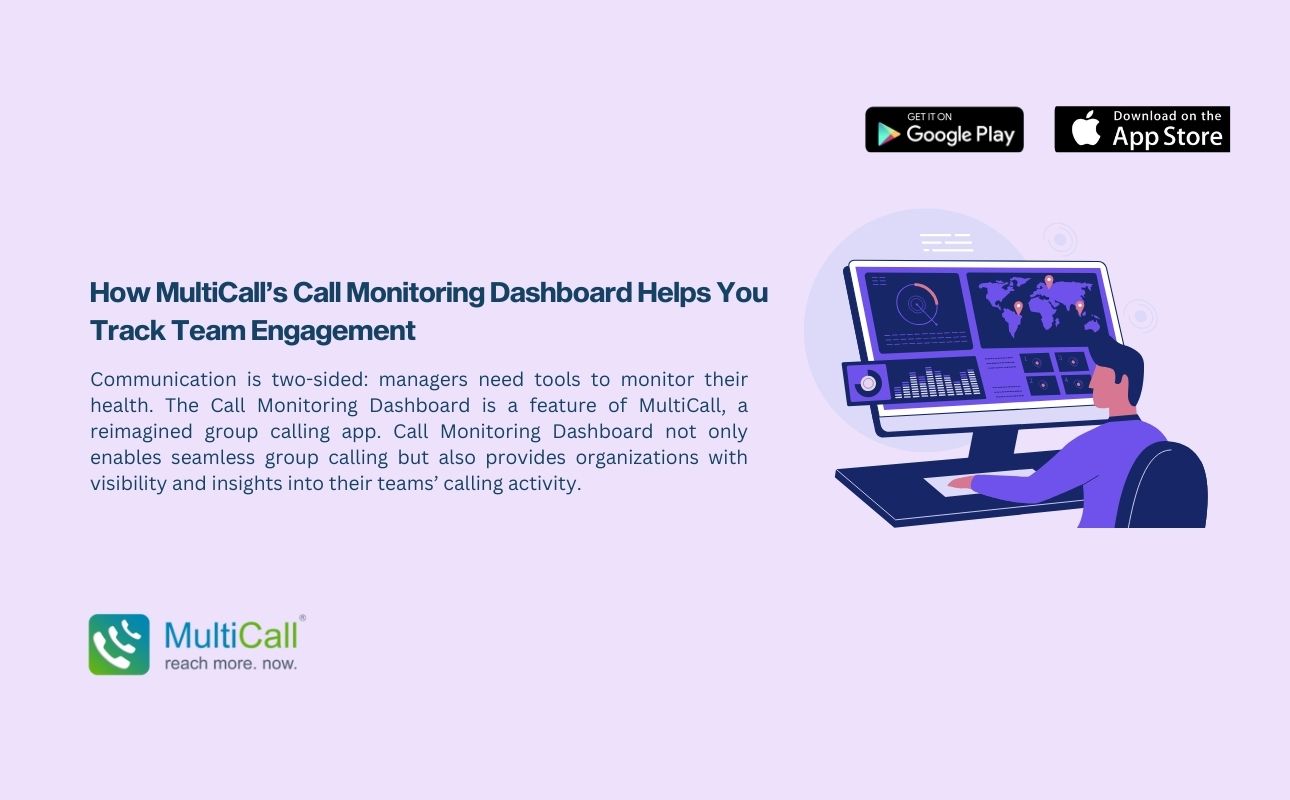
The Call Monitoring Dashboard is a separate screen or panel where call data and employee participation are compiled and updated in real-time. Think of it as an analytics interface where all the necessary engagement information related to the calling is aggregated for easy visibility.
In the past, we could only speculate whether teams were staying engaged with each other. With the Call Monitoring Dashboard, this is a thing of the past. Everything is transparent, and managers no longer have to guess or rely on feedback after the fact. Call logs, call duration, and employee engagement data are some of the data available in the dashboard. Together, they provide a transparent and cohesive view of employee and team communication.
Tracking Team Engagement Made Easy
Monitoring team engagement is not the same as calling frequency. It is concerned with the level of participation and involvement of staff in group communication. With the dashboard, businesses can now record and measure many of these engagement parameters:
Active Participation: Who is on the call regularly and who isn’t? What is the average number of members who attend?
Call Frequency and Duration: Are you talking too much or too little?
Attendance: Are there any regular no-shows? Do many join late?
By compiling all these parameters, businesses can understand how teams and members are engaged. This way, when there are inefficiencies or communication gaps, it’s easy to trace them back to participation metrics.
Call Monitoring Dashboard for Managers
Team leaders, especially those who manage distributed or hybrid workforces, have a tool in the Call Monitoring Dashboard. It’s a means of mirroring their employees and team members for a data-informed perspective of engagement. Here are some ways leaders can take advantage of the dashboard.
- Spot Inefficiencies: Bottlenecks at specific workstations are easy to identify when participation lags. A common example is slow responsiveness from teams whose roles are unclear or disengaged.
- Enhance Accountability: When employees know they can be counted, attendance on calls improves.
- Better Coaching:For team members who need special guidance or coaching, managers can use a dashboard report to have evidence-based discussions.
- Agenda for Shorter Calls: For instance, if employees are often on the call for a long time, you can discuss how to make meetings more concise.
The dashboard, therefore, is more than a tool for reporting and auditing; it is also an excellent capability for internal team development.
Conclusion
In a world where group calling is one of the primary work communication touchpoints, the Call Monitoring Dashboard offers support, including productivity.
By providing visibility on all the right engagement metrics for team meetings, the dashboard gives managers actionable data to take an informed approach to employee engagement. The impact of the dashboard, therefore, can be felt throughout the business. For the organization, it is efficiency and data-driven team management. For further information, contact us today!