
multicall

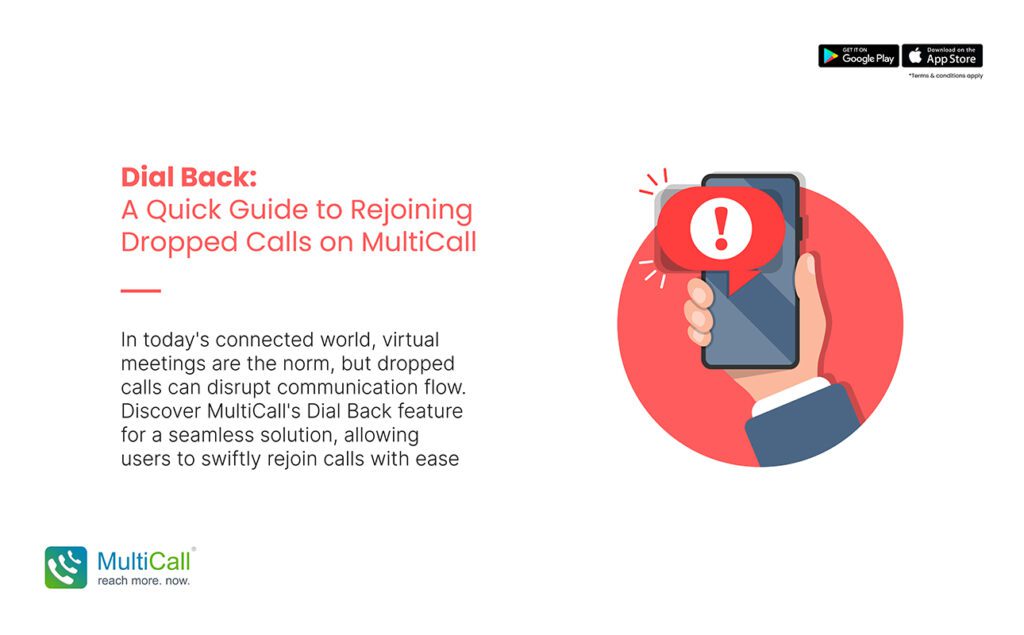
Dial Back: A Quick Guide to Rejoining Dropped Calls on MultiCall

In our increasingly connected world, where virtual meetings and calls have become the norm, the frustration of dropped calls can disrupt the flow of communication. MultiCall’s Dial Back feature presents a solution, enabling users to quickly and effortlessly rejoin calls. This guide explores how the Dial Back feature works and how it can be a lifesaver in various communication scenarios.


Understanding MultiCall’s Dial Back Feature

Dial Back is a user-centric feature in MultiCall designed to tackle the inconvenience of dropped calls. If a user gets disconnected from a call due to network issues or other interruptions, this feature allows them to rejoin the ongoing call with minimal effort and delay.

How to Use the Dial Back Feature

  1. Automatic Notification: When you are disconnected from a call, MultiCall automatically notifies you with a prompt to rejoin.

  2. One-Tap Rejoining: A simple tap on the prompt instantly reconnects you to the ongoing call, eliminating the need for manual redialing.

  3. Seamless Reconnection: The feature ensures you are back in the call quickly, reducing the chance of missing important parts of the conversation.
Untitled-1-Recovered-Recovered

Benefits of Using Dial Back

  1. Minimize Disruptions: Quickly rejoining calls minimizes disruptions in meetings, discussions, or negotiations.

  2. Time-Saving: Eliminates the time spent in manually dialing back into the call, especially useful in time-sensitive situations.

  3. Enhanced User Experience: Provides a smooth, hassle-free experience, bolstering the platform’s reliability and user satisfaction.

  4. Maintain Engagement: Ensures continuous engagement, particularly critical in business and collaborative environments.

When Dial Back Comes Handy

– In business meetings where every moment counts, and missing out on discussions isn’t an option.

– During webinars or training sessions, where losing connection can mean missing vital information.

– In collaborative team calls, where continuous participation is key to productive outcomes.

Conclusion

The Dial Back feature on MultiCall stands out as a testament to the platform’s commitment to uninterrupted communication. By offering a swift and efficient solution to rejoin dropped calls, it ensures that communication remains fluid, and vital interactions are not lost. This feature is a boon for anyone who values seamless connectivity in their professional or personal communication.


Contact Form


apple-store-app
google-play-app

YOU MAY ALSO LIKE

communication breakdown

How Enterprises Can Avoid Communication Breakdowns

Communication is the foundation of every successful enterprise. When communication flows smoothly, teams stay aligned, decisions are made quickly, and operations run efficiently. However, when communication breaks down, it can lead to confusion, delays, and costly mistakes. For large enterprises, avoiding these breakdowns is essential to maintain productivity and performance.

Read More »
audio

Why Reliable Audio Infrastructure Is a Competitive Advantage

In today’s competitive business environment, communication is not just a support function, it is a strategic advantage. Companies that communicate faster, clearer, and more reliably often outperform others. While many organizations focus on tools and platforms, the real strength lies in having a reliable audio infrastructure that supports seamless communication at all times

Read More »
group calls

When Every Second Counts: The Power of Instant Group Calls

In today’s fast moving business environment, speed plays a critical role in success. Whether it is handling urgent issues, making quick decisions, or coordinating teams, every second matters. Delays in communication can lead to missed opportunities, operational disruptions, and reduced productivity. This is where instant group calls become a powerful solution for businesses.

Read More »
communication

What Real-Time Communication Looks Like in Large Enterprises

Large enterprises operate in complex environments where multiple teams, departments, and locations must work together seamlessly. In such settings, real time communication is not just an advantage, it is a necessity. It ensures that information flows quickly, decisions are made efficiently, and operations continue without disruption.

Read More »
collaboration

The Future of Enterprise Collaboration Is Simpler Than You Think

Enterprise collaboration has evolved significantly over the years. From long email threads to complex project management tools, businesses have continuously tried to improve how teams work together. However, as systems become more advanced, they often become more complicated. The future of collaboration is not about adding more layers, but about simplifying communication to make it faster, clearer, and more effective.

Read More »
audio

Why Crisis Communication Needs Voice, Not Text

In times of crisis, communication becomes the most critical factor in managing situations effectively. Whether it is an operational issue, a service disruption, or an internal emergency, the way information is shared can determine how quickly and efficiently the problem is resolved. While text based communication has its place, voice communication proves to be far more reliable and impactful during high pressure situations.

Read More »