
multicall

6 Steps To Manage Your Weekly Review

Stop and Think. We often tend to forget this in the corporate scenario. Not stopping for a weekly review call can lead teams to lose track of tasks (completed or pending) and the performances relevant to them.

Lose sleep, and you build up a sleep debt. Similarly, miss a weekly review, and you build up its debt. It’s essential to treat this review call with as much importance as you would a sales or client meeting. And dedicating a review call each week to your progress only requires 6 steps to effectively manage them.

Set a clear day and time each week

Having a review call allows you to have an objective view on your week’s outputs, and even incentivizes you to be proactive with future tasks and their planning, in the manner above. Being objective, however, means having an aim.

 This accordingly means having a timeframe and a tool to enforce it with. One such tool to help you with this case is MultiCall, a group calling app dedicated to let you call many with the ease of calling one.

 MultiCall’s Call Scheduling assists in helping set up the meeting, not just in setting the date and time with the necessary team members, but in its ability to set the meeting to recur and auto-initiate the call as well.

 Clear your inbox

Our email service providers themselves try to sort mails into multiple inboxes, at different categories or levels of importance. Collaboration during remote working has presented itself as a WFH issue that makes our  inboxes open to virtually anyone, for putting another task onto our to-do list. How regular you clear your inboxes is entirely up to you, but the weekly review call is a perfect time to clean the slate.

 Have a “Waiting-For” list

The time taken to accomplish tasks during teamwork is sometimes subject to someone else’s delivery of outputs. Having a managerial position means that there are a multitude of such tasks that you are waiting for. It’s therefore appropriate that you keep reminders of all the things that you are waiting on; to get back from or get done by others.

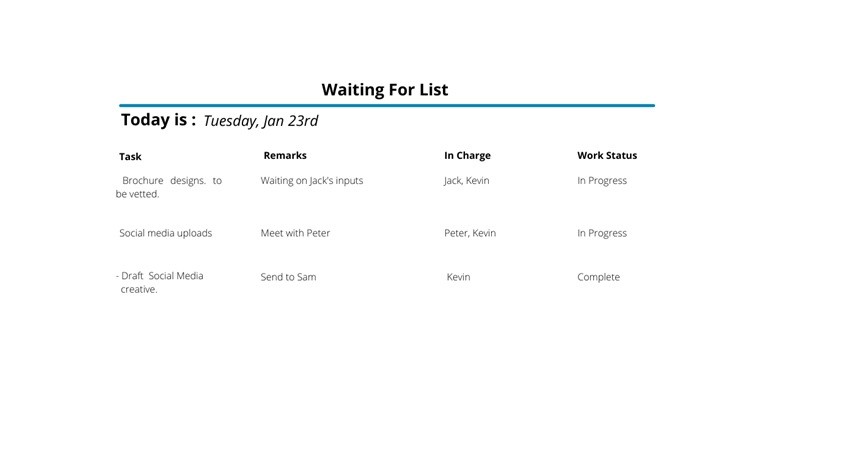
 Maintaining such a list would allow for a clear and prepared discussion, with active follow-up during the weekly review. One of the easiest ways to keep such a list is create an Excel or similar document to categorically list all tasks that are underway, with a column clearly allocated to who’s in charge of the task. The image above is an example of this.

 In order to be effective, this has to be accessible and editable by everyone in the weekly review calls.  Remember to update your waiting-for list on a regular basis!

Set high priority tasks for the upcoming week

Check and improve projects

As the adage goes, “what gets measured, gets managed”. Continuous improvement of process and productivity can be managed by regularly tracking your tasks during your weekly review.

As with digital marketing, where we constantly check our inputs’ performance by metrics like impressions and reach, it’s imperative to identify a relevant metric by which you want to measure your performance, and improve upon it subject to your goals.

This then can be compared and assessed during the weekly review call. You can use the above image as a reference! However, this doesn’t apply just to you, it applies to your team as well. Making sure that everyone has actively involved in the process is also critical to performance.

MultiCall’s Call Monitoring system helps here; not just in being able to monitor who is involved, but also to record and keep track of each review call.


Contact Form


apple-store-app
google-play-app

YOU MAY ALSO LIKE

multicall

 Is Your Business Over-Relying on Chat Apps

Many businesses today rely heavily on chat apps for daily communication. While messaging platforms are quick and convenient, they are not always the most effective way to handle important discussions. Over time, this dependency can create gaps in clarity, delay decision making, and reduce the quality of communication. Businesses need to evaluate whether chat apps are truly supporting their goals or slowing them down.

Read More »
multicall

Why Fast Coordination Matters More Than Perfect Slides

In many business situations, teams spend a lot of time preparing perfect presentations and detailed slides. While visuals can support communication, they are not always the most important factor. What truly matters is how quickly teams can connect, discuss, and make decisions. With Best Audio Conferencing Apps, teams can focus on real conversations instead of spending time perfecting slides that may not add real value.

Read More »
multicall

 Why Audio Calls Are Better Than Video for Focused Business Communication

In today’s fast moving business environment, communication needs to be clear, quick, and easy to manage. Video calls have become common, but they often add extra layers that are not always necessary. Audio calls offer a simpler and more practical way to connect. By using Best Audio Conferencing Apps, businesses can keep conversations smooth and focused without worrying about visual elements.

Read More »
multicall

Why Voice Communication Builds More Trust Than Emails

In business, trust is built through clear and genuine communication. While emails are widely used, they often lack emotional tone and personal connection. Voice communication brings a human element into conversations, allowing people to express tone, intent, and clarity.

Read More »
multicall

 The Real Reason Enterprises Are Moving Back to Voice

For several years, enterprises embraced video meetings, chat platforms, and collaborative dashboards as the future of communication. While these tools improved connectivity, they also introduced new challenges. Constant notifications, long message threads, and extended video sessions began to reduce focus and efficiency.

Read More »