

multicall

5 Reasons Why Managers Should Involve Their Team in Decision-Making

Decision-making is a staple in the manager’s everyday routine. From task delegation to crisis management,  the decisions that managers take can make or mar the organization’s success. But such decision-making isn’t always easy. Studies had shown that 60 percent of executives perceived bad decisions are about as frequent as good ones in their company. One way for managers to increase the probability of success in such decision-making would be to involve their team. This would be beneficial in 5 ways.

Less likelihood to give in to consensus

Given a chance, its human nature to try avoid conflict, so as to nurture a harmony among the group. In a professional sense, this would mean people, particularly managers, giving in to consensus. But it’s not necessarily the right choice.

It runs the risk of a less scrutinized evaluation of the problem, thus possibly leading to a less creative solution. Conflict or a disagree with team members may be uncomfortable, but it is necessary so as to reveal any hidden assumptions or data that can mislead individuals towards (or against) certain decisions.

Simply put, the greater the diversity in thoughts and opinions around the table, the more innovative the solutions put on the table. A MultiCall with your team would be useful here, as it lets you call many with the ease of calling one, and has the necessary features to ensure everyone has a chance to put forward their views without being cut out of turn.

Related: Why MultiCall is an Essential Tool for Managers

Increased Employee Engagement

Involving your team members in the decision-making process is a step that lets you show that you trust their opinion and value their contributions to the company as well. This in turn, builds employee engagement at your company. With highly engaged employees, companies can enjoy substantially better outcomes, with team members more likely to stay, and experience less burn-out at work.

Related: Disengaged employees and how to coach them

Increased self-awareness

Self-awareness is a crucial tenet to have as an employee or manager, letting high performers stand out with the value they deliver to the company. At its core, it allows a comprehensive ability to understand one’s own strengths, weaknesses, and managerial ways.

If you make every decision by yourself, you’re likely to risk missing data across various perspectives. Involving your team in the decision-making process cultivate self-awareness, avoiding decision-making blind spots in the process.

Higher Cognitive Load

In regular face-to-face interaction, nonverbal communication is natural, with all parties involved making or interpreting gestures and cues subconsciously. But sending such cues is much harder in video chats. Such cues could also mean different things in the context of a video meeting, as against a face-to-face one. Imagine looking to your side.

Face-to-face, that could mean looking to consult with someone else also in the meeting. But on video, that could come off as disinterested or distracted. Additionally, the situation of playing the balancing act of household and work activities under the same roof can further exacerbate this.

We have learned a lot from COVID-19, but still have uncharted roads ahead toward effectively and efficiently managing remote working, especially with regard to conferencing. Managers can try and motivate employees on call.

Nevertheless, more problems or issues may present themselves. The ability to start anew and address the issues at present is what would help people and companies alike to achieve and reach more, now.

Contact Form


apple-store-app
google-play-app

YOU MAY ALSO LIKE

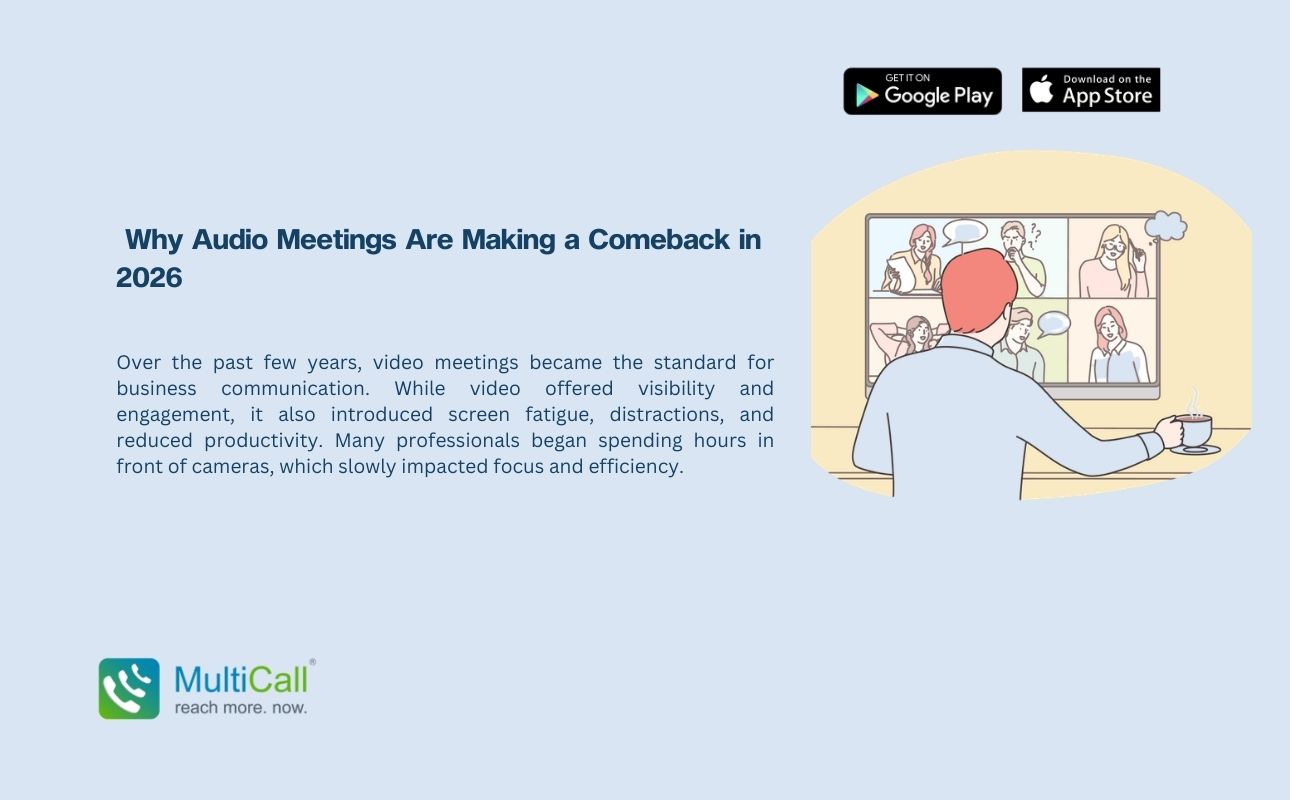
 Why Audio Meetings Are Making a Comeback in 2026

Over the past few years, video meetings became the standard for business communication. While video offered visibility and engagement, it also introduced screen fatigue, distractions, and reduced productivity. Many professionals began spending hours in front of cameras, which slowly impacted focus and efficiency.

Read More »

How One Missed Call Can Cost Your Business Crores

In business, opportunities rarely announce themselves twice. A single incoming call could represent a new client inquiry, a partnership proposal, a high value contract, or an urgent operational update. When that call goes unanswered, the cost is not just a missed conversation. It could mean losing revenue worth crores.

Read More »

  The 5 Biggest Communication Mistakes Enterprises Make

Enterprise success depends heavily on how well teams communicate. Strategy, execution, and client relationships all rely on clear and timely interaction. Despite having access to modern tools, many organizations continue to make communication mistakes that slow growth and reduce efficiency.

Read More »

Why MultiCall’s PSTN-Based Calling Services Are the Backbone of Reliable Business Communication

Reliable communication is critical for businesses that operate across teams, customers, and partners. While internet-based tools are popular, they are not always dependable, especially in areas with unstable connectivity. This is why PSTN-based calling continues to play a major role in business communication. MultiCall’s PSTN-based audio calling services provide a stable and trusted foundation that businesses can depend on every day.

Read More »