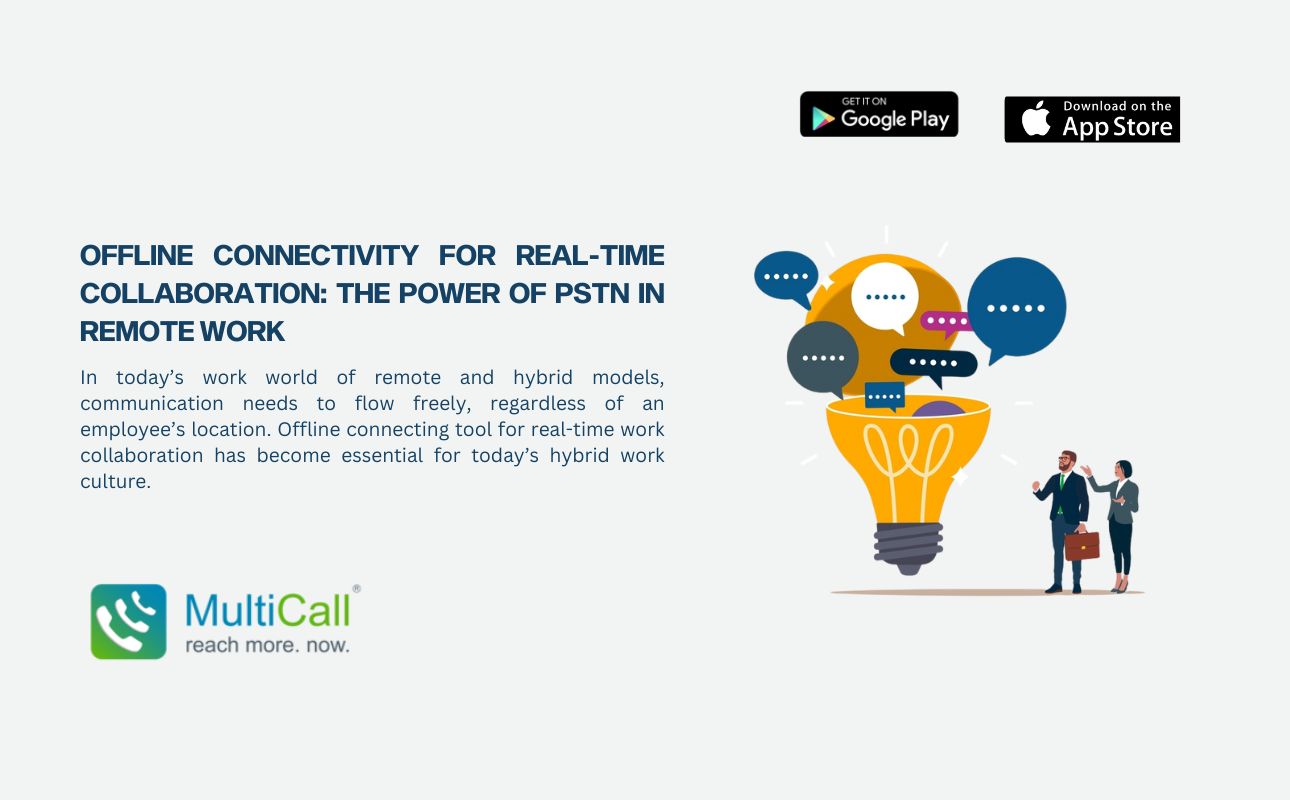
In today’s work world of remote and hybrid models, communication needs to flow freely, regardless of an employee’s location. Offline connecting tool for real-time work collaboration has become essential for today’s hybrid work culture.
Why Offline Connectivity is Important in Remote Work
When most people think about remote work or online meetings, they think of high-tech workstations or bustling city centers with the best fiber-optic internet available. The new reality is that an increasing number of remote and hybrid employees are based out of rural communities, and developing nations, or they are simply on the go. These employees can’t rely on stable online connectivity, which is especially true in emerging economies.
In these cases, offline connectivity can be a blessing to ensure communication happens in real time without skipping a beat. PSTN is one of the most widely used solutions to provide an alternative channel for remote employees to audio meetings, make critical phone calls, or receive timely updates without a high-speed data connection.
PSTN: The Ultimate Tool for Reliable Collaboration
The secret behind PSTN’s success is its ubiquity, dependability, and audio clarity. PSTN signals do not depend on the internet so there’s a high probability it is available in areas where mobile data signals don’t reach. Employees only need to dial into conference calls on a landline phone or mobile number.
PSTN has been smartly integrated into new collaboration platforms. Employees can join virtual meetings through a “call me” functionality or use a dial-in number. Global businesses operating across time zones also benefit from having local dial-in options for employees through PSTN without incurring heavy call charges.
Increase Productivity with Hybrid Connectivity
VoIP (Voice over Internet Protocol) is not the enemy of PSTN. In a remote work environment, smart communication platforms will automatically route calls and conferences between VoIP and PSTN based on the user’s network status. This is seamless to end-users and provides the necessary failover to prevent drop-offs and dropped calls.
Security and Compliance Advantages
For businesses in highly regulated industries such as finance, healthcare, and legal, PSTN can have the additional benefit of being fully compliant. The reason is that PSTN networks are under much stricter monitoring and governance by national telecoms regulators.
Users get traceability and the assurance of call audit trails that help meet strict regulatory standards of communication. Many enterprises also use PSTN more than VoIP for the ability to record calls for sensitive conversations and store them according to data governance standards.
PSTN’s Role in the Future of Work
As much as there are emerging technologies that want to disrupt PSTN, like the new VoIP-only services in virtualized contact center spaces, PSTN is not going anywhere. Telecommunications providers are responding to the needs of businesses with new PSTN services offered from the cloud.
This enables central management of global workforces where cloud PSTN integrations can be routed to ensure low-latency audio connectivity and link remote workers to in-office teams without relying on internet-only solutions.
In short, real-time collaboration in 2025 will not be about having the fastest and fanciest tool, but the most resilient and highly available communication tool. PSTN is one of those failproof tools that ensure real-time communication when working remotely without internet dependency.
Conclusion
For all the virtual meetings and digital collaboration tools, PSTN might seem like an ancient dinosaur. However, it is a workhorse in the background of remote communication to keep distributed employees connected when the internet connection goes kaput. PSTN works because it provides stability, and security, and is infinitely scalable to meet any size company’s needs.
Stay Connected, Always.
Do not let bad internet or cellular connections disrupt productivity. Give your remote and distributed workforce the power of PSTN-integrated communication and collaboration tools that always keep your team connected–online or offline.
Talk to our team today to learn how PSTN can revolutionize your remote working communication solutions.