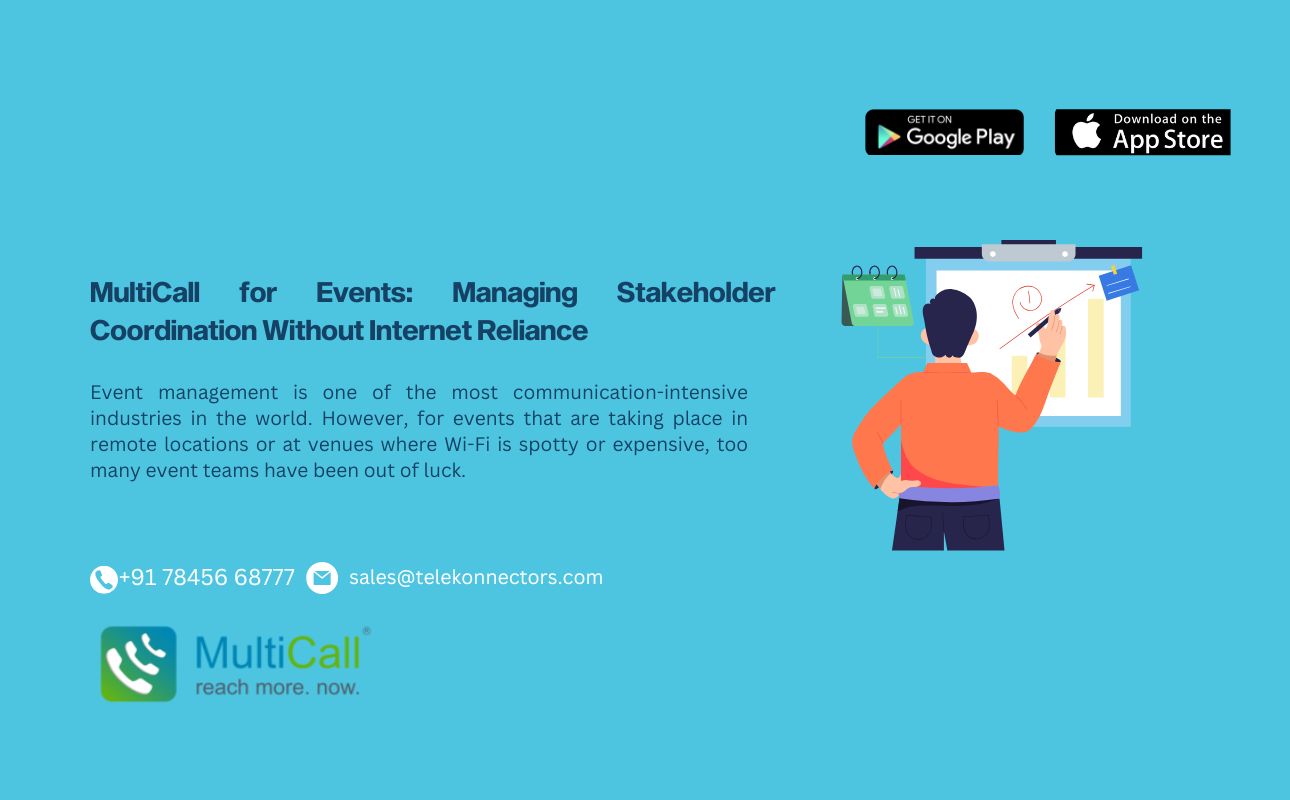
Event management is one of the most communication-intensive industries in the world. However, for events that are taking place in remote locations or at venues where Wi-Fi is spotty or expensive, too many event teams have been out of luck.
Supervisors can also use MultiCall to monitor and coordinate different areas and zones of events as they happen in real-time. For instance, registration, backstage, hospitality, parking, and stage production need to be synchronized. MultiCall’s call monitoring and logs ensure all of this is visible to those who need to know.
Advantages of MultiCall for Event Communication
MultiCall is a user-friendly, no-internet-required, PIN-free conference calling solution. It is based on regular mobile networks, which all phones support out of the box. Some of the key benefits for event teams are:
- Does not require internet during calls– The calls can be scheduled or initiated from any device, then connected from any phone without needing Wi-Fi.
- High-quality voice– Free from the distorted or robotic sound often found on traditional conference calling bridges. Calls start automatically with all participants.
Advantages of MultiCall over VoIP Apps for Events
While some of the popular VoIP calling and messaging apps seem like obvious tools for event communication, these have a number of limitations in practice. The drawbacks of VoIP services are as follows: a requirement for stable data connectivity, repeated logins and account creation, and complicated and non-intuitive UI.
Also, during large, high-traffic events, wi-fi networks become saturated and calls drop or audio stops working. This is when MultiCall’s core advantage of not needing data for the call itself helps – participants can use regular mobile networks, which are more stable.
Security and Privacy for Event Management Teams
Event information is sensitive, from guest lists and food allergies to vendor agreements and payment terms. MultiCall has been built with data privacy and security in mind. This is reflected in features such as:
- Masked phone numbers– Participants’ numbers are not visible to others.
- Audit logs– Admins can keep track of call participants and duration for accountability.
- Access controls– Event managers can control who can or cannot initiate/schedule calls.
Unlike most messaging and calling applications, which require internet data for their functioning, MultiCall allows you to schedule group calls without needing internet for the actual conversation. This, along with features like excellent voice quality and support for different types of phones and networks, is why many event management teams are now using MultiCall to coordinate their efforts.
Hence, MultiCall is a safer option than free, generic group chat tools, which mix personal contacts and data.
MultiCall for Event Management: The Bottom Line
The effective coordination between numerous people and groups makes it a challenging and communication-intensive process. When every detail needs real-time discussion, delays or miscommunications can impact the entire event. For event managers working with limited or expensive internet connectivity, coordinating between teams, vendors, and clients can be a tough problem.
With MultiCall, you can now get the simplicity, reliability, and cost-effectiveness of a real mobile phone with added features like PIN-free conference calling. Use MultiCall to bridge the coordination gaps in event management and enable your teams to focus on the things that matter.
Book a free demo or download the MultiCall app now to use MultiCall for Event Management. Or call our customer care executive to know more.