MultiCall is a group calling application with no internet dependency. It can help enterprises drive better communication and coordination by functioning on cellular networks. In high-latency environments, where internet-based VoIP applications struggle, MultiCall remains a steadfast, practical solution for these businesses by providing reliable, crisp audio with a reliable network.
Communication Challenges for Field Services and Logistics in Low Signal Regions
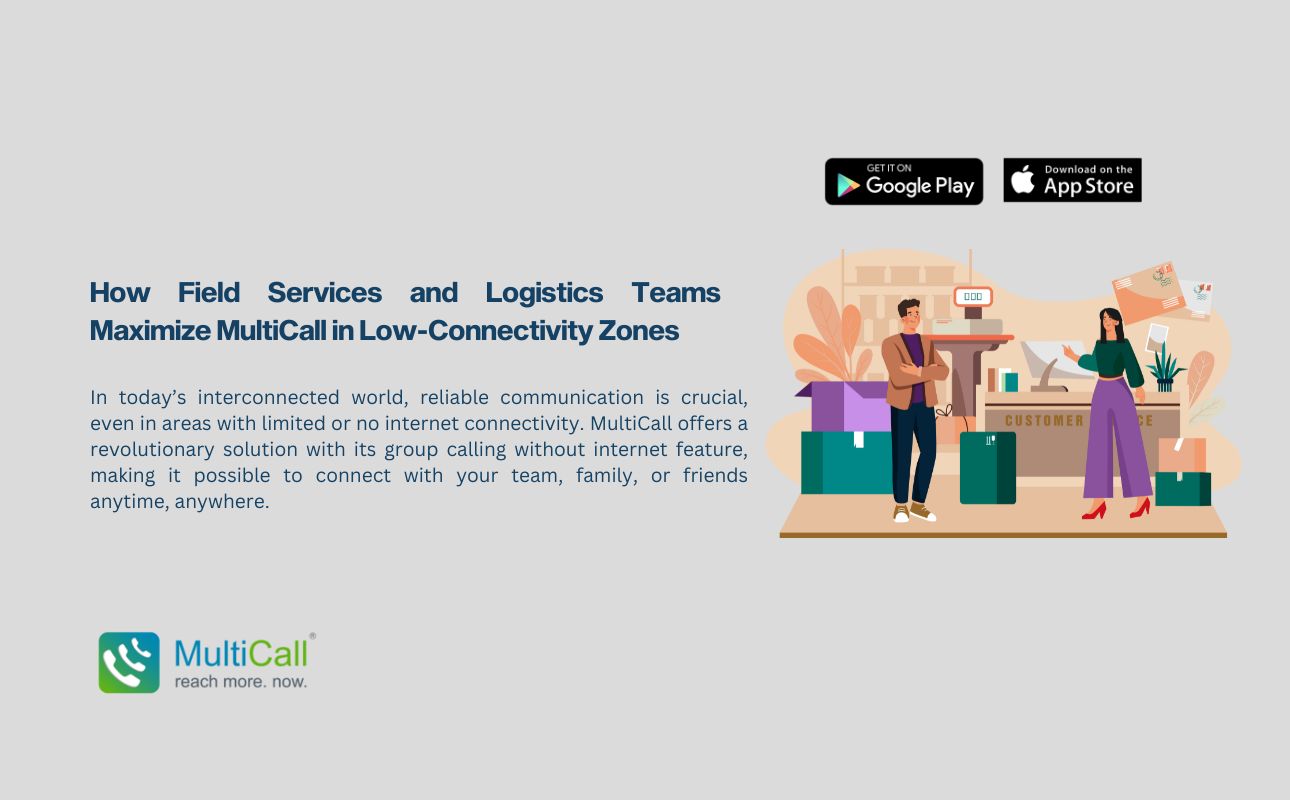
Drivers, couriers, field engineers, or sales professionals often have to work in low-connectivity zones by default due to their operational geographies. While urban areas, office spaces, or clusters enjoy high bandwidths, highway stretches or rural vicinities witness patchy or weak data signals.
Internet-based calling solutions may work well in high-end smartphone units with strong mobile data signals, but struggle in low-connectivity zones. This results in dropped calls, static-filled audio, or apps repeatedly crashing or timing out, even if calls connect.
Key Benefits of MultiCall for No/Weak Data Environments
* Mobile Network Reliance – The primary mode of connectivity for MultiCall is phone networks, unlike VoIP, which depends heavily on data. In regions where the mobile internet is patchy but calls still get through, MultiCall has the ability to stay connected.
* No Pin Codes to Enter – Workers don’t have to leave their activities to type URLs or enter four-digit pin codes. The process of connecting a team remains as simple as tapping a button on a web interface.
* Minimal Load on Devices – Mobile data apps use precious bandwidth and battery life, with video conferencing consuming more resources than voice calling. MultiCall has a significantly lower device load.
In summary, MultiCall’s utility in low-connectivity zones and rural geographies is primarily rooted in its ability to lower reliance on mobile data strength. This keeps logistics teams, delivery agents, and field service professionals connected in those situations where internet-only apps crash.
Industry Use Cases for Logistics and Field Service Agents
The following are use cases where MultiCall proves its value to logistics and field service agents:
- Collaborative Routing and Schedule Management
Delivery agents who are on highways or remote localities can quickly inform on-site supervisors about traffic or weather delays, or help in rerouting packages in time. MultiCall also solves the common problem of unreliable data connectivity on highway stretches.
- Instantaneous Status Updates
Chat applications, or video conferencing apps, often depend on stable internet connections and can experience delays when internet speeds are slow. MultiCall allows team supervisors to start a free group call in real-time to gather agent status updates.
- On-Site Field Support for Service Personnel
Engineers or maintenance professionals working in low-signal industrial zones or construction sites can have quick, precise conversations with back-office personnel or supervisors. While HD voice quality may be hampered a little in these locations, voice intelligibility remains sufficiently high to facilitate troubleshooting over MultiCall.
- State or Cross-Border Team Connectivity
Logistics operations span not just states, but cross borders and national boundaries. MultiCall’s ISD calling plans and its inclusion of international calling plans enable companies to communicate with global teams with ease and low cost.
Key Product Features for Low-Bandwidth Areas
Given how MultiCall operates outside the data connection, a few of its notable product features translate into meaningful benefits:
- Group Calling Without Internet or Mobile Data– The fact that teams can use their standard dial pad to enter numbers helps provide connectivity and continuity to business calls.
- Call Recording and Analytics Logs– Updates communicated on-field can be recorded or instantly stored and retrieved for transparency and accountability.
- Large-Scale Participation is Seamless –In a group call where participation ranges from three to three dozen, MultiCall is designed to maintain stable audio without clipping, which is essential for call managers and supervisors.
For these reasons, and many more, MultiCall has become an attractive solution for logistics teams and field service agents. In large part, it is down to how MultiCall offers data and connectivity resilience, a lean design, and zero internet dependency.
Why Enterprises Adopt MultiCall for Logistics and Field Service
Speed, crispness, and consistency are the hallmarks of any good field service business or logistics operation. In a competitive business environment, failing to keep drivers, logistics personnel, or field engineers connected because of poor or non-existent mobile internet availability is a drag on time and money.
By mitigating these gaps and providing a network-resilient solution, MultiCall has found favor with many industry leaders who strive for communication efficiency and team alignment.
Conclusion
Low connectivity zones for logistics and field service teams are an operational reality that can cause a breakdown in the value chain. Fortunately, a service or app that is internet-independent, like MultiCall, can help reduce communication gaps and latency.
MultiCall allows for group calling, robust audio quality, and enterprise-ready features for teams that operate on the road, in warehouse locations, or remote sites where the strength of traditional telephony is consistent. Call our executive now to know more.