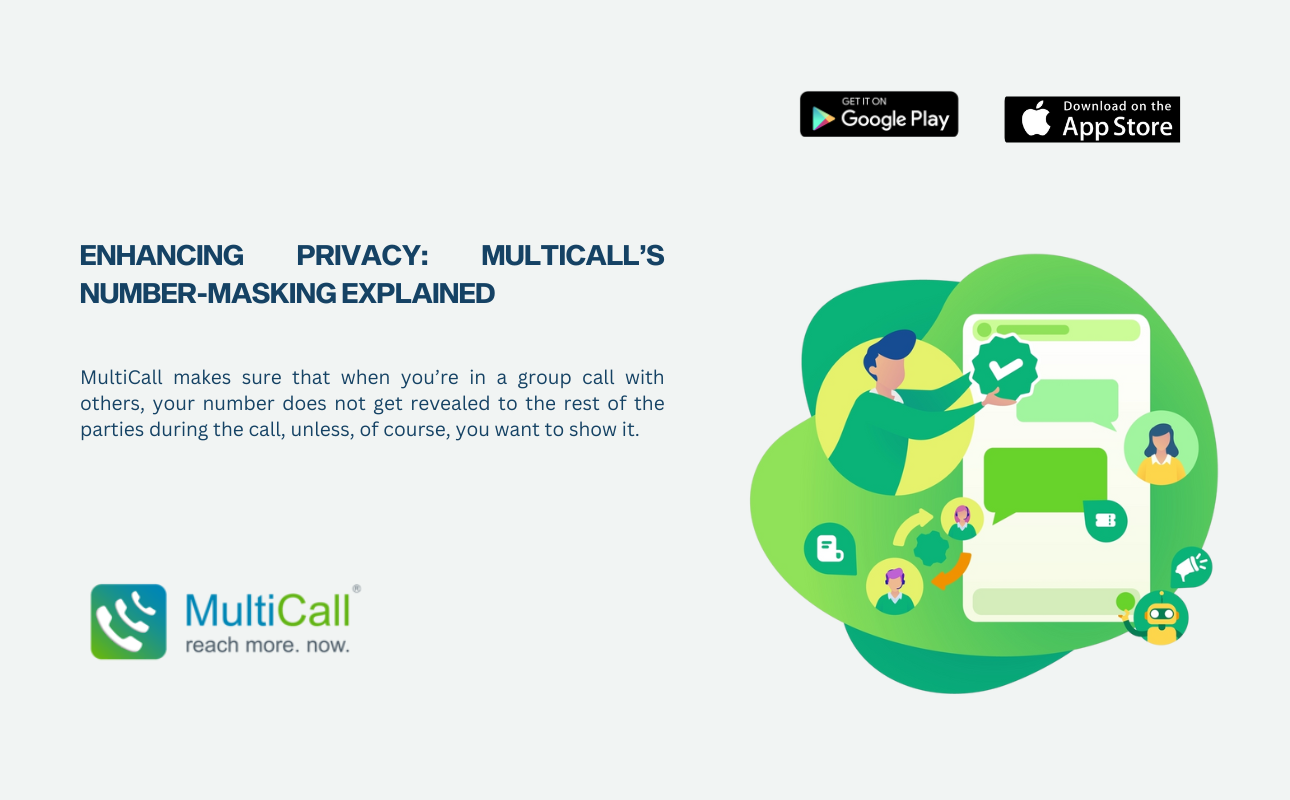
Number masking is a technology that conceals or hides the phone number of one or more parties during a call. The actual phone number is not visible to other participants on the call. The contact is then routed via a proxy number or remains hidden entirely, depending on the implementation. This can be a critical advantage when dealing with unknown clients, customers, or external stakeholders where privacy is a priority
How MultiCall’s Number-Masking Works
Masking the numbers of other participants on your group calls is a native feature of the MultiCall experience. This is how number masking works across our service:
When the group call happens, each user receives a normal PSTN call but with the other participants’ phone numbers hidden from each other.Caller ID for the participant may show a system number instead or be masked entirely.
This allows participants to truly hide their identity from other users, while still enabling robust voice communication to flow between users as a normal call.
The unique part is that this all happens without requiring setup or action on the part of the users themselves. It is a transparent default feature for group calls when all participants are unknown or unverified contacts.
When to Use Number Masking
- Business Meetings with External Partners
Business meetings can include group calls with external members who are not a part of the organization. If you host such a group call with clients, outside contractors, freelancers, or even outsourced team members, number masking helps you maintain professionalism and control of the communication to follow up as you see fit.
Customer service agents, call center teams, and customer support coordinators often receive high-volume support calls. In some organizations, these team members use personal cell numbers or shared internal extensions as part of the business.
- Event and Campaign Coordination
For event managers, PR professionals, and campaign coordinators who speak to multiple vendors, stakeholders, investors, or external partners, it can help to share a group call while still maintaining communications without the need to individually share phone numbers.
Benefits of Number Masking with MultiCall
- Zero Setup Hassle
Unlike some other providers, MultiCall’s number masking feature requires zero special setup, integration, custom coding, or special permissions. As a part of MultiCall’s core group calling offering, number masking comes standard, no strings attached.
- App-Free for Participants
Even if the recipient of the MultiCall group call invitation doesn’t have the MultiCall app, the call still works, and number masking still applies. In this sense, this unique feature is universal and accessible to all recipients.
- Secure PSTN Backbone
MultiCall runs over the tried-and-true PSTN backbone, rather than less-stable VoIP platforms, meaning your call experience is both more stable and secure. The entire masking process, as a result, doesn’t require or hinge upon data connectivity to preserve privacy.
- Improved Caller Trust
Customers and clients feel safer, knowing the businesses they deal with don’t make an easy leap into sharing contact details and have processes that respect their boundaries.
How to Enable It in Your Calls
For MultiCall group calls, number masking is not an optional setting you have to explicitly enable. Instead, number masking is automatically active on the MultiCall service in most cases by default, especially where there are group calls with participants that do not already have each other saved in their phonebooks.
MultiCall’s app and services take care of who can or cannot see whose number in a group call is based on native calling permissions, in most cases already configured on smartphones natively. The app will only ensure caller numbers are visible when mutual contact permissions already exist.
If you’re scheduling or setting up a new group call with a team and want to ensure that numbers remain private for all participants, simply add participants as normal. MultiCall’s app and server-side logic take care of the rest. Contact us today.