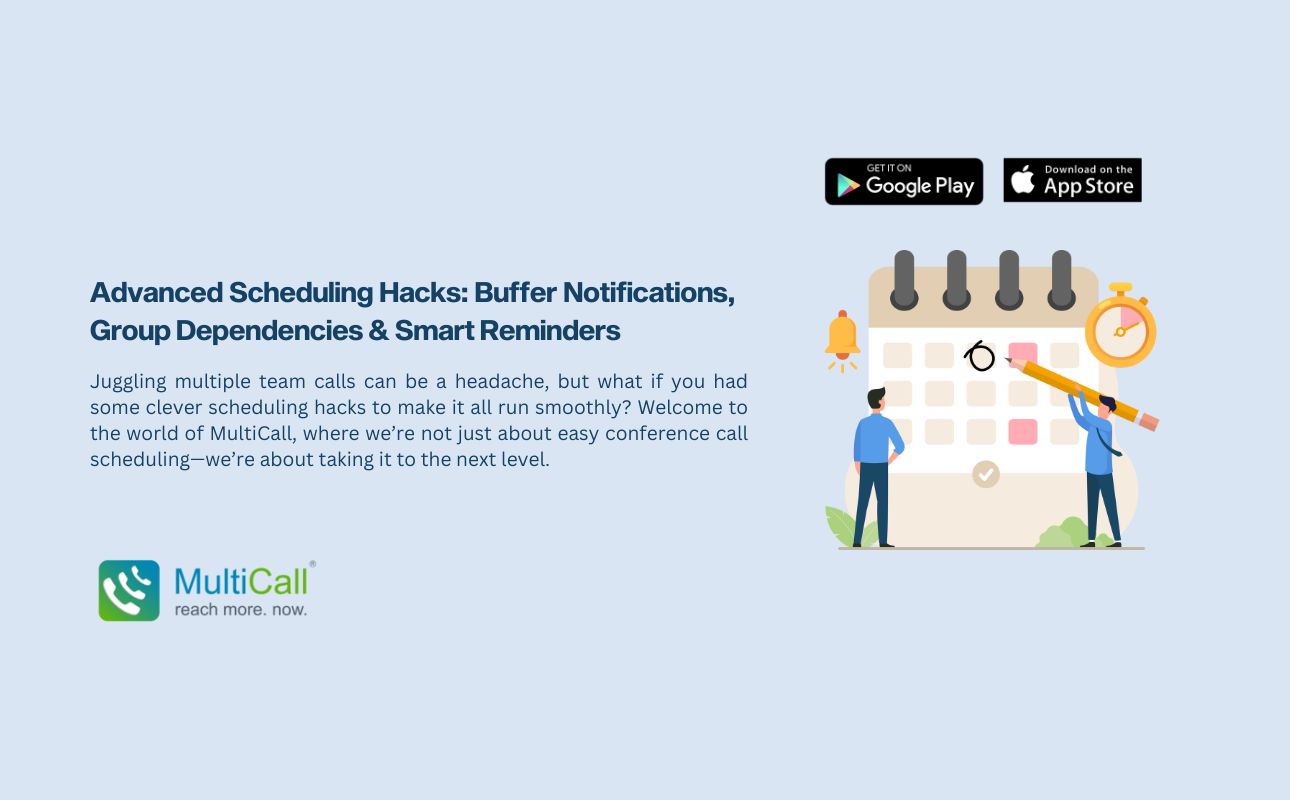
Juggling multiple team calls can be a headache, but what if you had some clever scheduling hacks to make it all run smoothly? Welcome to the world of MultiCall, where we’re not just about easy conference call scheduling—we’re about taking it to the next level.
Today, we’re diving into three features that will supercharge your group calling game: buffer notifications, group dependencies, and smart reminders.
Buffer Notifications: Get People to the Line Prepared
They either take off from their previous work and join mid-air or—wait for it—forget to join at all. Either way, it’s not optimal. Enter buffer notifications, our clever solution to set people up for success. Buffer notifications are exactly what they sound like: giving your participants a little extra time before a call starts so they can wrap up what they’re doing and jump on the call with their best foot forward.
Buffer notifications help participants come to the line with a little extra preparation time. This leads to more productive calls where everyone’s ready to dive in rather than rush into the chaos.
Group Dependencies: Align Schedules Across Your Groups
Picture this: you have three teams in your organization, all of which need to have a conference call, one after the other. The product team needs to talk to the marketing team, who in turn need to brief the customer support team. What if you could schedule calls that flow one into the other?
Group dependencies in MultiCall are all about managing this interconnected dance of calls. Think of it as a domino effect: when one call is scheduled, linked calls for other groups are also set up. This ensures seamless alignment of discussions across different departments or teams that are dependent on each other.
Smart Reminders: Making Sure People Don’t Ghost Calls
We’ve all been there: despite setting a meeting in your calendar, people can (and will) still ghost it. Busy schedules, plain forgetfulness, or unclear communication about the call’s importance—no-shows are the bane of group call managers everywhere.
Enter our third solution: smart reminders. A system that sends personalized nudges to each participant depending on their role and importance to the call.
Let’s say your team leads often receive invites but miss calls due to overlapping schedules. Smart reminders can catch these users earlier, ensuring key people show up. Conversely, if your interns tend to take a bit longer, reminders can be nudged closer to the call time for them.
Buffer + Dependencies + Smart Reminders = The Ultimate Scheduling Hack
Now let’s put it all together. The combined might of buffer notifications, group dependencies, and smart reminders will revolutionize how you handle scheduling.
- Buffer notifications set people up for success by giving them some wiggle room before a call.
- Group dependencies align related calls across different but interconnected groups.
- Smart reminders make sure that every head is in the game when it matters.
This isn’t just a three-pronged attack on bad scheduling; it’s a holistic, real-world approach to better scheduling. MultiCall doesn’t want you to be stuck playing whack-a-mole with no-shows and late joiners. We want you to be proactive, ensuring your team is ready, present, and dialed in.
Beyond Saving Time: Why Advanced Scheduling Matters
Scheduling is an exercise in time management, plain and simple. Ten minutes late for a scheduled call adds up to lost team productivity across the board. And the more people are involved in a group call, the more points of failure there are.
This is why MultiCall’s features help with advanced scheduling that takes into account real-world workflows. Buffer notifications set people up for success, helping them jump on calls prepared. Group dependencies ensure related but separate groups are linked in a logical communication workflow.
Conclusion
We hope these MultiCall features—buffer notifications, group dependencies, and smart reminders—help you approach group calling with a fresh perspective. To our enterprise, startup, and hybrid work teams out there, to anyone who’s ever grumbled at another no-show or scrambled for a late-joiner: we see you, we hear you, and we’ve built these features with you in mind.